
El Camino High School Trip
A Collaboration between Baltimore City College High School and Morgan State University’s Center for Religion and Cities
With generous support from the Henry Luce Foundation
“And why walk, if not to create a new set of possibilities? … Walking is an act of faith. Walking is, after all, interrupted falling. We see, we listen, we speak, and we trust that each step we take won’t be our last, but will lead us into a richer understanding of the self and the world.” - Garnette Cadogan, Walking While Black, 2016
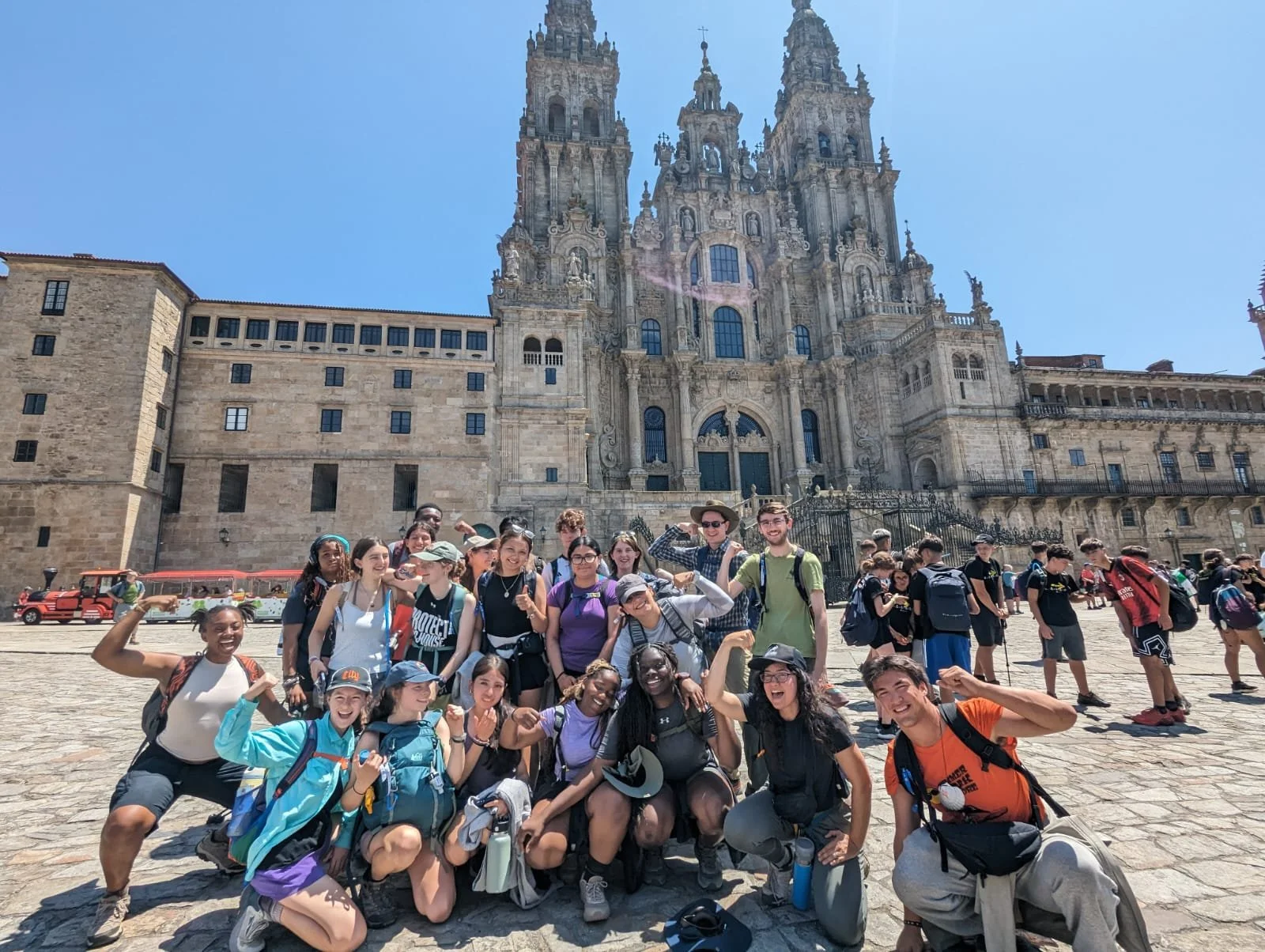
A photo of us making it to The Santiago de Compostela Arch-Cathedral Basilica in June of 2025! Invigorated and full of pride at this accomplishment, we were ready for rest and celebration
The CRC co-sponsored a study abroad trip to Spain and Portugal for City College High School students, offering a profound opportunity to engage with history and spirituality through the ancient pilgrimage routes of the Camino de Santiago. As students walk the historic trails that connect diverse communities across Spain, France, and Portugal, they were invited to reflect on their relationship to land, tradition, and their own inner selves—mirroring the CRC’s emphasis on reciprocal relationships and deep listening. The pilgrimage encouraged participants to contemplate questions of purpose, growth, and the impact they leave behind, fostering a sense of mindfulness and collective responsibility toward the land and communities they encounter.
By walking the Camino, students not only connect with a shared human heritage but also reflect on their own paths toward understanding, compassion, and a more meaningful life, embodying the CRC’s commitment to fostering leadership and community engagement through experiential learning.
Throughout the trip, students will have the chance to immerse themselves in the rich history of the Camino, a route that dates back to the Middle Ages and continues to serve as a spiritual and cultural conduit. Guided by the CRC’s principles of “Leave No Trace” and intentional engagement, participants will explore how their presence influences the environment and communities along the way, emphasizing respect, reciprocity, and sustainability. The journey also provides a unique platform for personal transformation—mirroring the CRC’s values of experimentation, dialogue, and co-improvement—where students can journal their experiences, question their assumptions, and embrace new perspectives.

The CRCs Learning Walks offer an invitation to reflect on our values and relationships to land and communities, to intentionally plan our next steps, and to grow to become who we want to be. To learn more about our Walking Fellowships, Tours, and materials, and to receive updates and invitations, please sign up for our newsletter below.
We are especially excited to collaborate with Baltimore City College High School and support their 2024 study abroad trip by providing:
Handmade Journals for each student by Pencil revolution Press
Research and Reflection Questions Materials
A $2,000 grant to support student travel
We hope that these resources, reflection activities, and journals are helpful tools for your journey on El Camino de Santiago in Spain!
El Camino de Santiago: History & Practices
The Camino de Santiago, translated into English as the Route of Saint James, is made up of different pilgrimage routes that connect across Spain, France, and Portugal. The interconnected routes leads to a cathedral Santiago de Compostela with a tomb said to contain the remains, or relics, of St. James. Santiago de Compostela is the capital of the Northwestern part of modern-day Spain called Galicia. Like other pilgrimage routes around the world, the Camino attracts thousands of tourists every year—some of whom view it as a religious pilgrimage—and is included in the UNESCO world heritage list. Dating back to the Middle Ages, the Camino follows a previously existing Roman trade route and was one way for medieval Christians to earn favor within the Catholic Church and demonstrate their devotion. Since emerging nearly 11 centuries ago, different lodgings—from informal to formal structures—have become available along the route and many of the communities located along the route welcome those participating in the pilgrimage as a custom. There are also different ways to document your physical and personal growth journey, some having a religious connotation for modern Catholics and others being oriented toward tourists and other non-Catholic walkers.
Sources Referenced
On St. James: https://vivecamino.com/en/the-tomb-of-santiago-apostle-how-was-it-discovered-no-807/
Map of routes: https://followthecamino.com/en/camino-de-santiago-routes/
Statistics on pilgrims: https://americanpilgrims.org/statistics/